In March 2011 I set out to explore a different sort of adventure. After 24 months of some of the most difficult life trials I have encountered thus far, I reconnected with Scott Hurst for a day of ice climbing in Hyalite Canyon. We left Rexburg early and got home late. In all we climbed 6 pitches of WI 3/4 in the "Dribbles" area. After two years of absolutely zero climbing of any kind, I felt good about leading the first two pitches of "Dribbles" without looking like a complete novice. My sincere appreciation for Scott's patience and encouragement can't be overstated.
Two days after climbing in Bozman I drove south to warm, sunny Utah, where Dave Clawson and I climbed hard, clean quartzite faces in Johnson Draw at the upper reaches of Ogden Canyon. Ranging from 5.10 to 5.11d, leading these climbs proved both challenging and rewarding. The greatest reward, however, proved to be the camaraderie with a dear friend.
Climbing, in various forms and varieties, has been a defining activity of my life. I have always felt that it influenced me in significant ways that contributed a great deal to defining me as a person. Though my hiatus from climbing gave me the opportunity to take advantage of some long-desired educational opportunities, I sacrificed an essential element of my identity by forsaking both the activity of climbing, and the priceless associations that are a part of my climbing partnerships.
It is not an exaggeration to say that my soul has experienced a great famine during the past two years. Scott deserves especial thanks for not allowing my conscious decision to abstain from climbing deter our friendship. Upon my return to the mountains - while tied to the end of a rope - two things became brilliantly clear to me. First, among my most cherished friendships are those with climbing buddies - of which my climbing partnership with Scott is likely the most significant; and second, when sharing time with dear friends, the association is evermore meaningful when rock, ice, ropes, and gear are involved!
March 18, 2013
February 8, 2011
Days Like These...

Not only were these ice climbs extremely fun, but many were first ascents put up by my good friend, Dean Lords. As much fun as the climbing is...the good friendships enjoyed along the way are probably the best reason to slog out to another great dagger of ice!
Check out the video and feel inspired!
July 8, 2010
Miskin-Steadman Route
Last weeks post was kind of a teaser to the route Kyle and I had been planning to climb on the north face of Sheep Mountain. The mountain lies along the main crest of the Lemhi range and is accessed on its north side via Long Canyon from the Gilmore townsite main road.
We spent more than a month this spring trying to get on the face between bouts of bad weather and high avalanche danger. The weather finally gave us a window and we were able to climb the route on Friday July 2, 2010.
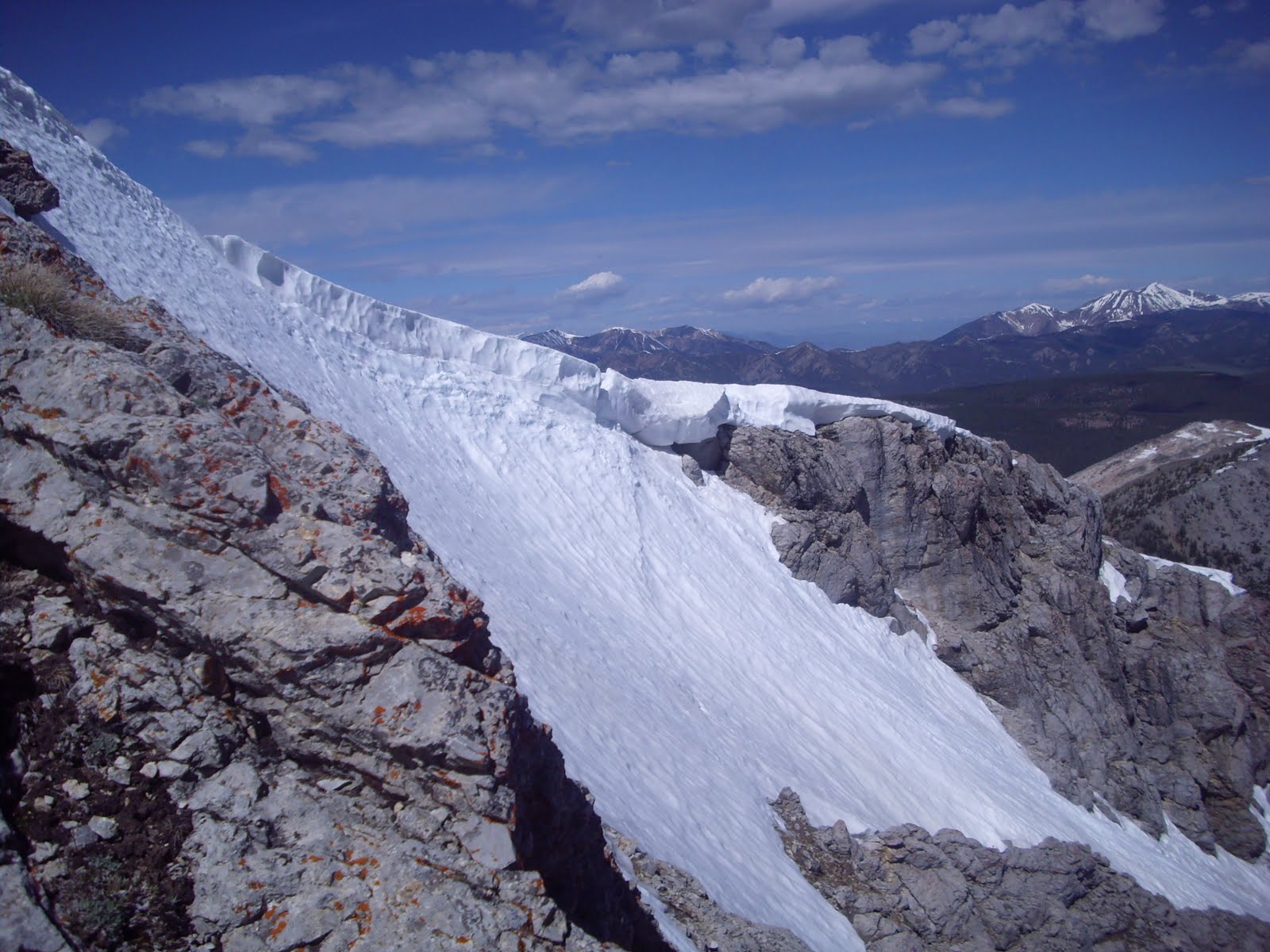
Both Kyle and I were a bit nervous as we approached the base of the route and gazed up at the steepness of the angle and the ominous overhanging cornice that guarded the exit onto the summit ridge. However, we found the snow, ice and rock to be solid, and Kyle even placed an ice piton in over 12 inches of hard alpine ice when building a belay anchor near the top of the couloir.
This route is easily accessed (we drove up Long Canyon in Kyles Subaru) and has one of the most beautiful and easy approaches I've ever done in the Central Idaho ranges.
I HIGHLY recommend this route to anyone who wants a moderate mountaineering objective with UNBEATABLE alpine views. It would serve as a good warm-up to the classic White Line Couloir (WI4, M5) on Peak 11308 in the Lost River Range.
Here is a brief route description and some photos that I hope get some guys excited to climb the route for themselves.
 Miskin-Steadman Route
Snow, AI 3; 1800 feet
Sheep Mountain North Face
Lemhi Range, Idaho
FA: July 2, 2010; Garon Miskin and Kyle Steadman
This beautiful route climbs the continuous couloir fourth from the left when looking at the north face of Sheep Mountain. The short, easy approach, remoteness and moderate nature of this route makes it a ‘must do’ for every Idaho mountaineer.
 Approach via Long Canyon from the Gilmore main road. The road up Long Canyon forks about mid-way. The LEFT fork is identified by a Forest Service sign indicating FS Road 1A, continue along the RIGHT for another 0.75 miles. When the road dips downward, locate a small pullout to the left and park. Hike directly west and drop quickly into a small drainage. More or less follow the drainage (when in doubt stay low and left) for approximately 1.5 miles on easy ground to a large meadow. The North Face of Sheep Mountain will be in full view. Cross the meadow to another smaller meadow and cross to the edge of the meadow, into the trees and emerge out of tree-line at the base of the route.
 The route begins directly out of tree-line and narrows very quickly. The lower one-third is 40-50 degree hard snow. After a few easy pitches, the couloir steepens to 60 degrees and becomes narrower. In the upper half the climbing becomes more varied and more difficult. The angle approaches 70 degrees and continually steepens with the final two pitches of 80 degree alpine ice and an exhilarating exit consisting of 30 feet of vertical alpine ice leading to the summit ridge. The route was protected with running belays in the lower sections and belay stances in the upper couloir were easily found and well protected.
Gear: 4 snow stakes, 4-5 lost arrows & knifeblades, 2 ice screws (18 cm), 4-5 small cams up to a #2 Camalot. The rock is solid and objective hazard is low, except for the overhanging cornice which extends along the entire rim of the upper bowl. Check avalanche conditions prior to ascending.
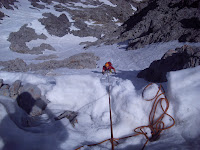 Descent: Descend the SW Ridge and locate the last couloir which appears to descend straight down to the base of the route. You know it’s the right one because the top is the most moderate angle from off the SW Ridge. At the point where the descent couloir appears to cliff out, traverse right (south), connecting narrow ledges until more moderate downclimbing is revealed. Alternately, descend all the way right into the lower section of the next couloir and downclimb steep, soft snow.

We spent more than a month this spring trying to get on the face between bouts of bad weather and high avalanche danger. The weather finally gave us a window and we were able to climb the route on Friday July 2, 2010.
Both Kyle and I were a bit nervous as we approached the base of the route and gazed up at the steepness of the angle and the ominous overhanging cornice that guarded the exit onto the summit ridge. However, we found the snow, ice and rock to be solid, and Kyle even placed an ice piton in over 12 inches of hard alpine ice when building a belay anchor near the top of the couloir.
This route is easily accessed (we drove up Long Canyon in Kyles Subaru) and has one of the most beautiful and easy approaches I've ever done in the Central Idaho ranges.
I HIGHLY recommend this route to anyone who wants a moderate mountaineering objective with UNBEATABLE alpine views. It would serve as a good warm-up to the classic White Line Couloir (WI4, M5) on Peak 11308 in the Lost River Range.
Here is a brief route description and some photos that I hope get some guys excited to climb the route for themselves.
 Miskin-Steadman Route
Snow, AI 3; 1800 feet
Sheep Mountain North Face
Lemhi Range, Idaho
FA: July 2, 2010; Garon Miskin and Kyle Steadman
This beautiful route climbs the continuous couloir fourth from the left when looking at the north face of Sheep Mountain. The short, easy approach, remoteness and moderate nature of this route makes it a ‘must do’ for every Idaho mountaineer.
 Approach via Long Canyon from the Gilmore main road. The road up Long Canyon forks about mid-way. The LEFT fork is identified by a Forest Service sign indicating FS Road 1A, continue along the RIGHT for another 0.75 miles. When the road dips downward, locate a small pullout to the left and park. Hike directly west and drop quickly into a small drainage. More or less follow the drainage (when in doubt stay low and left) for approximately 1.5 miles on easy ground to a large meadow. The North Face of Sheep Mountain will be in full view. Cross the meadow to another smaller meadow and cross to the edge of the meadow, into the trees and emerge out of tree-line at the base of the route.
  The route begins directly out of tree-line and narrows very quickly. The lower one-third is 40-50 degree hard snow. After a few easy pitches, the couloir steepens to 60 degrees and becomes narrower. In the upper half the climbing becomes more varied and more difficult. The angle approaches 70 degrees and continually steepens with the final two pitches of 80 degree alpine ice and an exhilarating exit consisting of 30 feet of vertical alpine ice leading to the summit ridge. The route was protected with running belays in the lower sections and belay stances in the upper couloir were easily found and well protected.
 Gear: 4 snow stakes, 4-5 lost arrows & knifeblades, 2 ice screws (18 cm), 4-5 small cams up to a #2 Camalot. The rock is solid and objective hazard is low, except for the overhanging cornice which extends along the entire rim of the upper bowl. Check avalanche conditions prior to ascending.

June 30, 2010
New Gear and New Territory
Most guys have to beg, plead and perform all kinds of menial tasks in order to convince their wives to let them buy new gear. Mysha has never put me through the gauntlet when it comes to purchasing new (or more) climbing gear. Although I have a very extensive collection of gear that would probably be sufficient to stock a small retail outlet, there are a few items which I have always had at my disposal through other climbing partners.
For instance, I provide the cams, my partner provides the ice screws. Not that I don't have ice screws, but I did realize that I did not have enough snow pickets to attempt an early season climb that Kyle Steadman and I have been eyeing. Two pickets won't get us through and so I ordered a few more, along with some additional gear that I have needed to get for a couple of years.
My dear friend, Dean Lords, also finds himself in the market for some new gear - out of necessity rather than by choice. He has been working with a tight-knit group to develop the climbing at the Dam Boulder site. He had cached three crash pads near one of the project routes and last week all three pads were stolen!
Many wonderful offers of support have gone out to Dean and his wife Heather, which speaks very highly of the majority of climbers and friends whose lives have been touched by the Lords'. Dean and Heather have handled the situation with enviable dignity and I am certain that projecting at the Dam Boulders will continue in spite of the poor choice someone made when they took property that did not belong to them.
Kyle and I leave tomorrow to climb in the beautiful Lemhi Range. I was once told that the entire range was a crumbling pile of limestone and few worthwhile climbs exist. To a great extent the range is comprised of rotting limestone. But for those willing to explore the unknown, the Lemhi's hold some of the most beautiful and rewarding lines I have ever seen. I've been looked at sceptically for climbing in the Lemhi's during the winter - when temperatures are regularly in the -40 range. But frozen, snow-covered limestone isn't crumbly and is actually a lot of fun to climb.
 The avalanche danger has kept Kyle and I off the snow-covered slopes for the past several weeks. Here's a picture of the pile of avalanche debris we were trying to avoid by delaying our climbing plans originally scheduled for the first part of June. (Click the picture to enlarge). Notice the heavy avy debris at the base of the couloirs. It kind of looks like a river of snow. Below is another picture that shows Kyle making his way across the toe of the debris zone. The smell of the pines was intoxicating and the mixture of rock, snow, sky and friendship made for a great afternoon.
 It may be difficult to see, but if you look carefully you might notice the waterfall in the center of the cliffband on the left. The angle of this face is quite a bit steeper than it seems from these pictures. Sections of the couloirs are vertical to overhanging. Because of the suddenly warmer temperatures and the relative lateness of the season, Kyle and I decided to focus our attention away from our original objective, the couloir on the right in the first picture.
Overnight temperatures have not been dipping below freezing, although it was kind of chilly as the sun went down on the mountains. The toe of the debris field is over 9,000 feet and there was a definite chill on the slight breeze that blew through the pines during our walk out.
Exploring the regions that lie off the edge of most peoples radars brings a small factor of fear with it. For me it is not the fear of failure, or the fear of danger; rather it is the fear of finding the ultimate climb - the cherished prize - then realizing that every climb that follows will somehow be shadowed by that ultimate objective.
I used to think that the ultimate climb was the first 5.12 sport route I could lead, or making it to the top of the world on the summit of Mt. Everest. My climbing objectives reflected this thinking. But experience and maturity (and the example of good mentors) have taught me that we should not let the esteem of others define our Ultimate Expedition. Everest is no longer the supreme goal. Other mountains comprise my list of high-altitude objectives, and the passion I feel for the unexplored ridges and couloirs of the Central Idaho ranges grows with each season.
The beauty of the alpine environment west of Rexburg is largely unappreciated. With some luck, those who follow my meager efforts to explore more of the Lemhi and Lost River Ranges will see them as I do. Maybe some of the spirit of exploration that leads so many to head for the slopes of Everest will awaken an appreciation for what lies at the threshold of our own back doors here in Southeast Idaho.
Maybe, maybe not. Either way, I hope you enjoy the pictures and find some time to get out into these ranges and discover something of the magic that lies in the heart of the Central Idaho mountains for yourself. After all, the ultimate expedition is life itself. It's a unique journey for each of us and only we can define what it is, or where it will go.
For instance, I provide the cams, my partner provides the ice screws. Not that I don't have ice screws, but I did realize that I did not have enough snow pickets to attempt an early season climb that Kyle Steadman and I have been eyeing. Two pickets won't get us through and so I ordered a few more, along with some additional gear that I have needed to get for a couple of years.
My dear friend, Dean Lords, also finds himself in the market for some new gear - out of necessity rather than by choice. He has been working with a tight-knit group to develop the climbing at the Dam Boulder site. He had cached three crash pads near one of the project routes and last week all three pads were stolen!
Many wonderful offers of support have gone out to Dean and his wife Heather, which speaks very highly of the majority of climbers and friends whose lives have been touched by the Lords'. Dean and Heather have handled the situation with enviable dignity and I am certain that projecting at the Dam Boulders will continue in spite of the poor choice someone made when they took property that did not belong to them.
Kyle and I leave tomorrow to climb in the beautiful Lemhi Range. I was once told that the entire range was a crumbling pile of limestone and few worthwhile climbs exist. To a great extent the range is comprised of rotting limestone. But for those willing to explore the unknown, the Lemhi's hold some of the most beautiful and rewarding lines I have ever seen. I've been looked at sceptically for climbing in the Lemhi's during the winter - when temperatures are regularly in the -40 range. But frozen, snow-covered limestone isn't crumbly and is actually a lot of fun to climb.
 The avalanche danger has kept Kyle and I off the snow-covered slopes for the past several weeks. Here's a picture of the pile of avalanche debris we were trying to avoid by delaying our climbing plans originally scheduled for the first part of June. (Click the picture to enlarge). Notice the heavy avy debris at the base of the couloirs. It kind of looks like a river of snow. Below is another picture that shows Kyle making his way across the toe of the debris zone. The smell of the pines was intoxicating and the mixture of rock, snow, sky and friendship made for a great afternoon.
You can see some of the trees hit by the avalanche. They're leaning over. I should have thought to turn around and shoot a picture of all the trees behind me - some were torn in half and looked especially gnarly!

Overnight temperatures have not been dipping below freezing, although it was kind of chilly as the sun went down on the mountains. The toe of the debris field is over 9,000 feet and there was a definite chill on the slight breeze that blew through the pines during our walk out.
Are you curious where this little gem of a peak is? It's in the Lemhi Range - can you guess which peak? Stay posted over the next few days for more pictures and to see if you guessed correctly! After we climb this north facing peak, I'll share more details of the climb - and the location. The picture below gives you a better idea of how steep the couloirs really are. Dean Lords tells me he's 
an alpine climber trapped in a sport climber's body. His skill at sport climbing is world-class, no doubt. I've seen him in the mountains too, though, and he's not half-bad at mountaineering. If there's anything I excel at it's probably high-altitude mountaineering. My lungs just seem to do better in thinner air, and I get a boost of energy above 15,000 feet. But even at 10,000 feet my heart is overjoyed at being in the mountains. These high-angled couloirs really excite me and I can't wait to see what lies above the base of the mountain.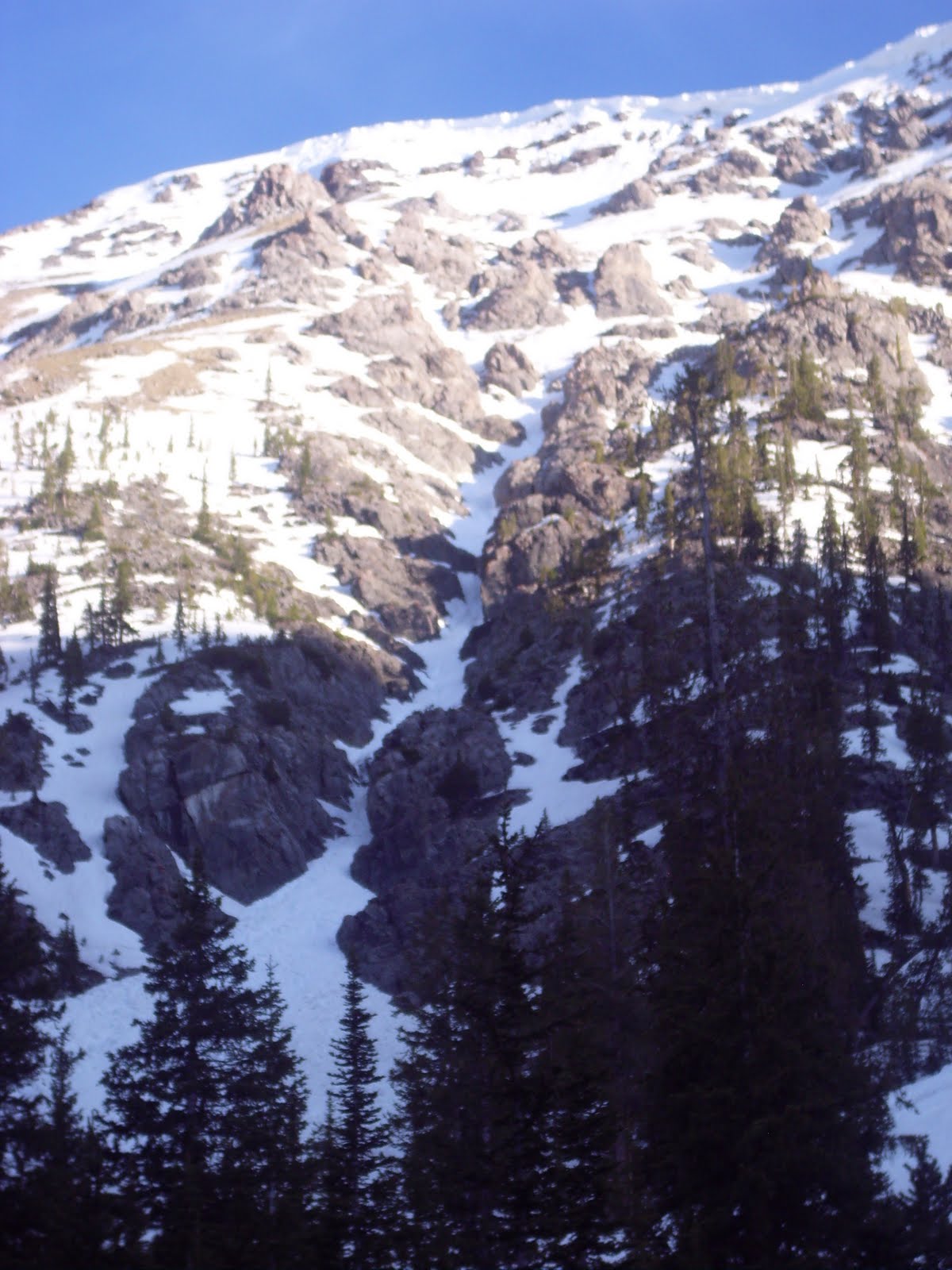
Exploring the regions that lie off the edge of most peoples radars brings a small factor of fear with it. For me it is not the fear of failure, or the fear of danger; rather it is the fear of finding the ultimate climb - the cherished prize - then realizing that every climb that follows will somehow be shadowed by that ultimate objective.
I used to think that the ultimate climb was the first 5.12 sport route I could lead, or making it to the top of the world on the summit of Mt. Everest. My climbing objectives reflected this thinking. But experience and maturity (and the example of good mentors) have taught me that we should not let the esteem of others define our Ultimate Expedition. Everest is no longer the supreme goal. Other mountains comprise my list of high-altitude objectives, and the passion I feel for the unexplored ridges and couloirs of the Central Idaho ranges grows with each season.
The beauty of the alpine environment west of Rexburg is largely unappreciated. With some luck, those who follow my meager efforts to explore more of the Lemhi and Lost River Ranges will see them as I do. Maybe some of the spirit of exploration that leads so many to head for the slopes of Everest will awaken an appreciation for what lies at the threshold of our own back doors here in Southeast Idaho.
Maybe, maybe not. Either way, I hope you enjoy the pictures and find some time to get out into these ranges and discover something of the magic that lies in the heart of the Central Idaho mountains for yourself. After all, the ultimate expedition is life itself. It's a unique journey for each of us and only we can define what it is, or where it will go.
June 19, 2010
Moab Weekend
With a couple of days to dedicate to climbing, I figured the best thing to do was figure out where the warmest weather was. Moab was looking pretty good, so I called Eric and Rob in Utah and they were already thinking like me!
We decided to throw back to the "old days" of dirtbag climbing when we would toss our gear and just enough food into the car and head for the desert crags of Zion, Moab or St. George. Those days are responsible for some of my fondest memories and this trip proved very similar.
Someone said it's the simple things in life that make a person happy. I figure that if they meant the smell of chalk, a tall finger splitter and the feel of cam slotting perfectly on the first go, they sure had it right!
I hit Top 40, a lieback crack rated 5.8 for the warm-up, while the others scattered to put ropes on various faces and cracks along Wall Street. Dave Clawson and I had our eyes on Baby Blue (5.11a) and after leads on Lacto-Mangulation (5.10b) and others, we headed down the road to start slamming some cams into what appeared to be a GREAT finger crack.
Just as Dave roped up for the first lead, a few drops of rain began to fall and we wondered if we had traveled far enough south to get out of the wet weather that has been extending the already too-long spring season. Undaunted we huddled in close to the rock and realized that the route was overhung enough to be protected from the rain. We smiled...BIG!
 I spotted Dave on the cruxy start until he could slot a yellow Metolius and clip the rope. Powerful moves requiring left-handed ring-locks resulted in upward progression. One orange Metolius cam, two blue, another yellow and one #7 nut later Dave finally found a spot where he could alternate hand jams and wiggle the pump out of his forearms. Since the crack flared over the last 15 feet, it took some creative cam placements above the bomber #2 BD that protected the slightly runout finish, but Dave showed us his mad Joshua Tree crack-climbing skills and pulled a
powerful finish through the flared finger crack to the chains.
 With raindrops falling faster and in greater quantity, I tied-in and began the ascent, cleaning the cams as I went. The movement on the lower 2/3 of the route was AWESOME! Powerful toe jams, ring locks and modified lie-backs kept the climbing interesting and creative; and smooth, fluid upward progression was the reward of my labors.
I too found the crux finish difficult for my slender fingers as I battled the deceptively flaring crack that ran the final 15 feet. After four falls I finger jammed like my pride depended on it as passers-by stopped their vehicles and took a couple of photos. I finally made the final 10 feet (thanks largely to a toe jam that cranked some serious pressure onto my little toe) and pulled up to the chains.
Baby Blue proved to be all we hoped it would be and was definitely a good climb to get the season started.

We decided to throw back to the "old days" of dirtbag climbing when we would toss our gear and just enough food into the car and head for the desert crags of Zion, Moab or St. George. Those days are responsible for some of my fondest memories and this trip proved very similar.
Someone said it's the simple things in life that make a person happy. I figure that if they meant the smell of chalk, a tall finger splitter and the feel of cam slotting perfectly on the first go, they sure had it right!
I hit Top 40, a lieback crack rated 5.8 for the warm-up, while the others scattered to put ropes on various faces and cracks along Wall Street. Dave Clawson and I had our eyes on Baby Blue (5.11a) and after leads on Lacto-Mangulation (5.10b) and others, we headed down the road to start slamming some cams into what appeared to be a GREAT finger crack.
Just as Dave roped up for the first lead, a few drops of rain began to fall and we wondered if we had traveled far enough south to get out of the wet weather that has been extending the already too-long spring season. Undaunted we huddled in close to the rock and realized that the route was overhung enough to be protected from the rain. We smiled...BIG!
 I spotted Dave on the cruxy start until he could slot a yellow Metolius and clip the rope. Powerful moves requiring left-handed ring-locks resulted in upward progression. One orange Metolius cam, two blue, another yellow and one #7 nut later Dave finally found a spot where he could alternate hand jams and wiggle the pump out of his forearms. Since the crack flared over the last 15 feet, it took some creative cam placements above the bomber #2 BD that protected the slightly runout finish, but Dave showed us his mad Joshua Tree crack-climbing skills and pulled a
powerful finish through the flared finger crack to the chains.

I too found the crux finish difficult for my slender fingers as I battled the deceptively flaring crack that ran the final 15 feet. After four falls I finger jammed like my pride depended on it as passers-by stopped their vehicles and took a couple of photos. I finally made the final 10 feet (thanks largely to a toe jam that cranked some serious pressure onto my little toe) and pulled up to the chains.
Baby Blue proved to be all we hoped it would be and was definitely a good climb to get the season started.
Dave Clawson leading Baby Blue, 5.11a 100 ft.

May 28, 2010
Springtime In Southeast Idaho
The great thing about Idaho is that you have a better chance of winning the lottery than being able to guess what tomorrow;s weather is going to be. You may doubt that this is a great thing, but can you imagine living somewhere like California where it was ALWAYS hot? Or what about Seattle where it ALWAYS rains? Variety is the spice of life and I've been kept on my toes this spring bouncing from early season mountaineering to catching a few warm hours on the local crags trying to get my sport climbing up to par.
 Mysha is still my favorite belayer (sorry guys - she's just prettier than you are) and so I have headed to the crag at Heise and Paramount a couple of times to get some chalk on my fingers and try out a new lightweight harness I recently purchased from C.A.M.P. The harness was great, but almost a little too slimmed down for full function in racking gear. However, it feels like wearing almost nothing at all and the fit makes the harness move with me very well!
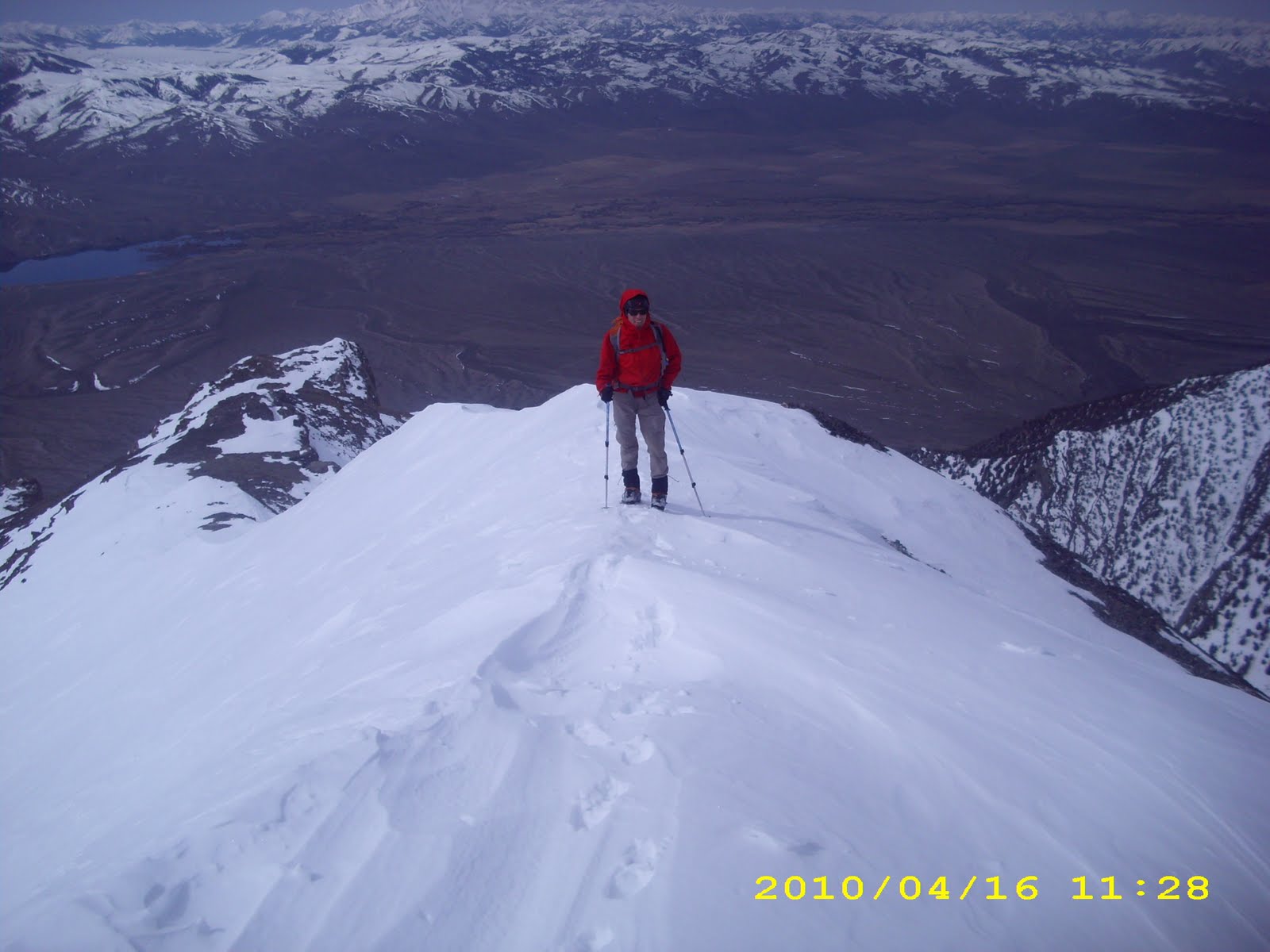
Mysha likes the green color of the harness, so I think I'll keep it. Scott Hurst and I headed to the mountains a couple of weeks ago and climbed Super Gully on Lost River Peak (Class 3 ridgeline preceded by moderate snow climbing). The route was in good condition, but the evidence of recent avalanches was obvious. We moved into the gully and then across the throat of it with caution. The upper portions were especially good and quite stable.
The knife-edge ridge from South to North Summits was slightly easier than when I did the climb last Spring. The weather turned out to be perfect, and we enjoyed a quick decent on mash potato snow!
Scott and Kyle Steadman returned last week with a group of BYU-Idaho students and found a very different mountain. The weather was good, the conditions of the gully were also good, but Kyle reported a massive cornice running the length of the summit ridge. The cornice was heavily wind-loaded and when Scott cautiously stepped onto the ridge, his body weight triggered an avalanche. Needless to say, the group wisely retreated from the walk across the knife-edge ridge.
 Wind and graupel also hit the group, feeding them a
substantial dose of true mountain conditions. Kyle returned from the encounter addicted to the battle that is mountaineering, and eager for more!
I'm hoping Memorial Day allows Scott and I to hit the crag with our families. If the weather is lousy in the valley, I'll just set my sights on the mountains and plan for winter climbing conditions. It hardly seems like nest week will be the first week of June. I wonder if there's still ice on Short Line Couloir.....
 Mysha is still my favorite belayer (sorry guys - she's just prettier than you are) and so I have headed to the crag at Heise and Paramount a couple of times to get some chalk on my fingers and try out a new lightweight harness I recently purchased from C.A.M.P. The harness was great, but almost a little too slimmed down for full function in racking gear. However, it feels like wearing almost nothing at all and the fit makes the harness move with me very well!
Mysha likes the green color of the harness, so I think I'll keep it. Scott Hurst and I headed to the mountains a couple of weeks ago and climbed Super Gully on Lost River Peak (Class 3 ridgeline preceded by moderate snow climbing). The route was in good condition, but the evidence of recent avalanches was obvious. We moved into the gully and then across the throat of it with caution. The upper portions were especially good and quite stable.
The knife-edge ridge from South to North Summits was slightly easier than when I did the climb last Spring. The weather turned out to be perfect, and we enjoyed a quick decent on mash potato snow!
Scott and Kyle Steadman returned last week with a group of BYU-Idaho students and found a very different mountain. The weather was good, the conditions of the gully were also good, but Kyle reported a massive cornice running the length of the summit ridge. The cornice was heavily wind-loaded and when Scott cautiously stepped onto the ridge, his body weight triggered an avalanche. Needless to say, the group wisely retreated from the walk across the knife-edge ridge.
 Wind and graupel also hit the group, feeding them a
substantial dose of true mountain conditions. Kyle returned from the encounter addicted to the battle that is mountaineering, and eager for more!
I'm hoping Memorial Day allows Scott and I to hit the crag with our families. If the weather is lousy in the valley, I'll just set my sights on the mountains and plan for winter climbing conditions. It hardly seems like nest week will be the first week of June. I wonder if there's still ice on Short Line Couloir.....
September 28, 2009
Paradise Buttress - North Face Route
Paradise Buttress (9,727 ft.)
North Face Direct – II, 5.6
FA: Garon Miskin & Kyler Miskin
September 18, 2009
Friday Kyler, Jarik and I did some exploring in the Lemhi Range. In particular I was eager to return to a large buttress on the south side of Gilmore Peak that I had been to earlier this summer.
Dean and Heather Lords and I had done some recon earlier this summer near the south side of Gilmore Peak. Our objective then was to scout a possible base camp site for backcountry skiing in the huge cirques formed by Gilmore Peak, Sheep Mountain and other subsidiary ridges in between.
The high alpine meadow we discovered had impressed me so much that I couldn’t wait to return. Equally as impressive were two steep buttresses that jut out from a ridgeline between Gilmore Peak and Sheep Mountain.
Our intention Friday was to do some recon, snap some photos and assess the probability of routes on the buttresses. As we scrambled over the glacial scree at the base of the first buttress my eyes were drawn to the beautiful white and gray quartzite that forms the majority of the buttress.
The Lemhi Range is notorious for its rotten limestone and the solid quartzite made me almost giddy. Kyler and I found 4-5 pitches of fun, steep rock with scrambling on the lower and upper sections of the route. We climbed two roped pitches, approximately 200 feet each, through the middle of the route.
The alpine feel and mostly solid rock makes this route fun and aesthetic. The short approach (20-30 minutes) over easy ground makes this a great destination for short alpine routes. The other buttress, which is taller and steeper, probably holds a good number of harder alpine and multi-pitch wall routes.
Here’s the skinny.
The Route:
Cross the open meadow on the North Side of the Buttress and re-enter the trees on the opposite (west) side. Keep an eye on the buttress and when you are inline with the center of the North Face, turn left and head straight for the buttress. A couple of huge boulders near the bottom of the scree indicate you are in the right place.
Continue up the scree field straight toward the North Face from the large boulders and locate the bottom of an east/west tending ramp. A small, grassy area marks the start of the ramp.
 The crux pitch, a 200-foot chimney, rises directly up from the J-shaped tree (5.6). The lower section is wide, shallow and run-out.
 Easy 5th class climbing with only moderate exposure above the arête will bring you near a large boulder. Experienced parties will want to coil ropes at this point since the remainder of the route is far less exposed. Make a fishhook left around the boulder and gain the upper section of the arête. The upper arête now leads to the obvious roof-shaped bellyroll pitch. At the southern end of bellyroll step across onto the large chockstone, then stem left onto the headwall face. Using positive face holds traverse up and left to gain the top of the headwall (5.4).
Descent:
From the summit, work south-east toward the forested ridge, staying high. In a very short distance the ridge proper is gained. Walk East along the ridgeline (in the trees) until you cross an obvious game trail. Take this trail and work to your left. Descend the ridge toward the meadow.
The further East one progresses before descending the ridge, the easier the descent terrain will be. A series of good game trails exists all over this ridge and all eventually work their way down to the meadow. Just remember not to get to far off to the right.
First Pitch - 4th Class Ramp Belaying from the White Alcove


North Face Direct – II, 5.6
FA: Garon Miskin & Kyler Miskin
September 18, 2009
Friday Kyler, Jarik and I did some exploring in the Lemhi Range. In particular I was eager to return to a large buttress on the south side of Gilmore Peak that I had been to earlier this summer.
Dean and Heather Lords and I had done some recon earlier this summer near the south side of Gilmore Peak. Our objective then was to scout a possible base camp site for backcountry skiing in the huge cirques formed by Gilmore Peak, Sheep Mountain and other subsidiary ridges in between.
The high alpine meadow we discovered had impressed me so much that I couldn’t wait to return. Equally as impressive were two steep buttresses that jut out from a ridgeline between Gilmore Peak and Sheep Mountain.
Our intention Friday was to do some recon, snap some photos and assess the probability of routes on the buttresses. As we scrambled over the glacial scree at the base of the first buttress my eyes were drawn to the beautiful white and gray quartzite that forms the majority of the buttress.
The Lemhi Range is notorious for its rotten limestone and the solid quartzite made me almost giddy. Kyler and I found 4-5 pitches of fun, steep rock with scrambling on the lower and upper sections of the route. We climbed two roped pitches, approximately 200 feet each, through the middle of the route.
The alpine feel and mostly solid rock makes this route fun and aesthetic. The short approach (20-30 minutes) over easy ground makes this a great destination for short alpine routes. The other buttress, which is taller and steeper, probably holds a good number of harder alpine and multi-pitch wall routes.
Here’s the skinny.
The Route:
Cross the open meadow on the North Side of the Buttress and re-enter the trees on the opposite (west) side. Keep an eye on the buttress and when you are inline with the center of the North Face, turn left and head straight for the buttress. A couple of huge boulders near the bottom of the scree indicate you are in the right place.
Continue up the scree field straight toward the North Face from the large boulders and locate the bottom of an east/west tending ramp. A small, grassy area marks the start of the ramp.
Scramble up steep 4th class terrain, tending up and right to the top of the ramp. As one approaches the top of the ramp, look for a short, vertical chimney (5.4). Set a belay and climb the chimney. At the top of the chimney gain a narrow ledge and follow a series of narrow ledges up and left to the “J-tree ledge”. This narrow, down-sloping ledge will be obvious from the J-shaped tree growing across it. Directly to the left of the J-shaped tree is a small alcove. Set a belay in this alcove.
 The crux pitch, a 200-foot chimney, rises directly up from the J-shaped tree (5.6). The lower section is wide, shallow and run-out.
About mid-way up, the chimney turns to the right and narrows significantly. Better gear is found in the back of the narrow, vertical chimney. Continue to the top of the upper chimney and make an exposed step to the right and onto a small arête. Locate a large tree and boulders several feet above the top of the chimney and set a belay.
 Easy 5th class climbing with only moderate exposure above the arête will bring you near a large boulder. Experienced parties will want to coil ropes at this point since the remainder of the route is far less exposed. Make a fishhook left around the boulder and gain the upper section of the arête. The upper arête now leads to the obvious roof-shaped bellyroll pitch. At the southern end of bellyroll step across onto the large chockstone, then stem left onto the headwall face. Using positive face holds traverse up and left to gain the top of the headwall (5.4).
A short scramble on solid rock will lead to the small summit.
Descent:
From the summit, work south-east toward the forested ridge, staying high. In a very short distance the ridge proper is gained. Walk East along the ridgeline (in the trees) until you cross an obvious game trail. Take this trail and work to your left. Descend the ridge toward the meadow.
The further East one progresses before descending the ridge, the easier the descent terrain will be. A series of good game trails exists all over this ridge and all eventually work their way down to the meadow. Just remember not to get to far off to the right.
First Pitch - 4th Class Ramp Belaying from the White Alcove


Summit - Paradise Buttress

Summit
June 10, 2009
Spring Alpine Climbing
Spring in the Central Idaho mountain ranges brings ephemeral ice that can be as difficult to catch in good condition as sunny day has been the past two weeks. However, Scott Hurst and I decided to head over to peak 11,308 and take our chances on White Line Couloir.
What we found was fat ice and beautiful weather. Ok, “fat” is a relative term when it comes to alpine ice – and even more relative when it comes to the White Line. But compared to the lean years pictured in Dean Lords’ blog, the pillar on the first technical pitch was huge!
The unusually wet season (which doesn’t seem to be ending any time soon) made for great mixed conditions on the route.
Though both Scott and I had both been to the summit before, we decided to make our first ascent of the White Line in true alpine fashion and trudged the additional 1,500 feet (through knee-deep snow) all the way to the summit.
The descent was beautiful – more post-holing in soft snow that had been rock solid just hours before. It never ceases to amaze me how quickly conditions can change according to the appearance or absence of the sun.
Dean has been recommending this route to us for years now and we have been stymied by either scheduling conflicts or from missing the short window of weather that allows the ice to form on the route.
Though Dean has pioneered more difficult mixed routes in the Lost River Range, this route is a “Dean Lords Gem” that every Idaho mountaineer should experience. The rock was solid, protection was great, though it took some creativity to find, and the aesthetics of the route are unbelievable!
Justin Avenius and Mike Shaw teamed up on the route just six days after Scott and me. They reported similar conditions and also found the route enjoyable and well worth the time taken.
White Line gave me such a bug for spring alpine climbing that I went the following week to Lost River Peak (12, 078 ft.) and climbed Super Gulley (Snow/Class 3).
I planned to do the route solo but just as I was leaving the trailhead, an SUV pulled up and four member of the Idaho Alpine Club poured out in eager anticipation of climbing the same route. They graciously let me join them. At the south summit one finds a long, knife-edge ridge with fantastic exposure on both sides. This last ridge traverse made the slog up the broad gully, which is often skied, well worth the effort.
Not knowing was kind of terrain to expect, I left my snowboard at home and was wishing I hadn’t as I started the descent. I guess I’ll just have to go back and ride the gully another time!
What we found was fat ice and beautiful weather. Ok, “fat” is a relative term when it comes to alpine ice – and even more relative when it comes to the White Line. But compared to the lean years pictured in Dean Lords’ blog, the pillar on the first technical pitch was huge!
The unusually wet season (which doesn’t seem to be ending any time soon) made for great mixed conditions on the route.
Though both Scott and I had both been to the summit before, we decided to make our first ascent of the White Line in true alpine fashion and trudged the additional 1,500 feet (through knee-deep snow) all the way to the summit.
The descent was beautiful – more post-holing in soft snow that had been rock solid just hours before. It never ceases to amaze me how quickly conditions can change according to the appearance or absence of the sun.
Dean has been recommending this route to us for years now and we have been stymied by either scheduling conflicts or from missing the short window of weather that allows the ice to form on the route.
Though Dean has pioneered more difficult mixed routes in the Lost River Range, this route is a “Dean Lords Gem” that every Idaho mountaineer should experience. The rock was solid, protection was great, though it took some creativity to find, and the aesthetics of the route are unbelievable!
Justin Avenius and Mike Shaw teamed up on the route just six days after Scott and me. They reported similar conditions and also found the route enjoyable and well worth the time taken.
White Line gave me such a bug for spring alpine climbing that I went the following week to Lost River Peak (12, 078 ft.) and climbed Super Gulley (Snow/Class 3).
I planned to do the route solo but just as I was leaving the trailhead, an SUV pulled up and four member of the Idaho Alpine Club poured out in eager anticipation of climbing the same route. They graciously let me join them. At the south summit one finds a long, knife-edge ridge with fantastic exposure on both sides. This last ridge traverse made the slog up the broad gully, which is often skied, well worth the effort.
Not knowing was kind of terrain to expect, I left my snowboard at home and was wishing I hadn’t as I started the descent. I guess I’ll just have to go back and ride the gully another time!
March 31, 2008
Winter in the Lost River Range
Ten days ago, Scott, Mike and I climbed the Northwest Ridge of Peak 11,308. This peak sits just Southwest of Borah Peak and boasts a couple of the finest mixed lines south of the Canadian Rockies. The weather was clear and cold, and there was no mistaking the fact that Spring had NOT sprung in the Central Idaho mountains.
Although the ridge is not technically difficult, don't be lured into thinking it is an easy objective. The ridge requires mountaineering skills, knowledge of avalange terrain and conditions, route-finding skills, and the ability to negotiate the knife-edge ridge while maintaining your composure. The ridge is wildly exposed which makes it quite possibly the most aesthetic ridge climb I have ever done.
Views of Borah, Sacajawea and Mt. Idaho are impressive along the full length of the climb.
We encountered mixed conditions and spent an hour or more slogging through the sugar snow of the lower ridge. At times we were chest deep in the loose powder, and had to worm our way over steep steps and around gnarly trees that reached their branches toward us like something out of a J.R.R. Tolkein novel!
Once we attained the upper ridge (above tree line) the exposure became even more dramatic. Large snow bowls line both sides of the serrated ridgeline and hold HUGE amounts of snow, hanging precariously above gigantic avalanche chutes. At one point, we were forced to drop off the ridge for about 50 feet and ascend the very top margin of one such snow bowl. As we sunk to our waist in the soft powder, our hearts skipped a beat and tense moments ticked away to the rhythm of our punding hearts...we waited...hoping our footsteps hadn't triggered an avalanche. Then, clinging to the rock wall of the ridgeline that loomed above us, we pressed on and again regained the backbone of the ridge.
A series of false summits made it evident that we still had a long way to go. The summit view was definitely worth the effort and we spent an hour on top eating high fat foods and taking photos. When we couldn't stand the extreme cold any longer, we descended. The radiant heat beating off the limestone wall was a welcome sensation. We took 12 hours from car to car, a little slow given the length of the ridge, but not bad considering the depth of the snow.
Experienced mountaineers have wisely backed away from climbing this dramatic ridge. We felt a true sense of accomplishment in having reached the summit and, most importantly, getting back to the car safely.
Our hope is that the mixed climbing on 11,308 is in fat condition in another 2 weeks. Even if it's not, this trip marks only the beginning of great adventures in the gem known as the Lost River Range!
Although the ridge is not technically difficult, don't be lured into thinking it is an easy objective. The ridge requires mountaineering skills, knowledge of avalange terrain and conditions, route-finding skills, and the ability to negotiate the knife-edge ridge while maintaining your composure. The ridge is wildly exposed which makes it quite possibly the most aesthetic ridge climb I have ever done.
Views of Borah, Sacajawea and Mt. Idaho are impressive along the full length of the climb.
We encountered mixed conditions and spent an hour or more slogging through the sugar snow of the lower ridge. At times we were chest deep in the loose powder, and had to worm our way over steep steps and around gnarly trees that reached their branches toward us like something out of a J.R.R. Tolkein novel!
Once we attained the upper ridge (above tree line) the exposure became even more dramatic. Large snow bowls line both sides of the serrated ridgeline and hold HUGE amounts of snow, hanging precariously above gigantic avalanche chutes. At one point, we were forced to drop off the ridge for about 50 feet and ascend the very top margin of one such snow bowl. As we sunk to our waist in the soft powder, our hearts skipped a beat and tense moments ticked away to the rhythm of our punding hearts...we waited...hoping our footsteps hadn't triggered an avalanche. Then, clinging to the rock wall of the ridgeline that loomed above us, we pressed on and again regained the backbone of the ridge.
A series of false summits made it evident that we still had a long way to go. The summit view was definitely worth the effort and we spent an hour on top eating high fat foods and taking photos. When we couldn't stand the extreme cold any longer, we descended. The radiant heat beating off the limestone wall was a welcome sensation. We took 12 hours from car to car, a little slow given the length of the ridge, but not bad considering the depth of the snow.
Experienced mountaineers have wisely backed away from climbing this dramatic ridge. We felt a true sense of accomplishment in having reached the summit and, most importantly, getting back to the car safely.
Our hope is that the mixed climbing on 11,308 is in fat condition in another 2 weeks. Even if it's not, this trip marks only the beginning of great adventures in the gem known as the Lost River Range!
February 19, 2008
The Question is..."Why?"
Since man first started climbing mountains and rocks with the objective of getting to the top, the question has loomed, "Why do you climb?" I too have been asked that question countless times. My answer has always been the same. The difference between me and George Mallory, when asked why he attempted to climb Mt. Everest said, "Because it's there" is that I don't have a snappy one-liner to answer with.
I've climbed alot of things that are "there". And so have alot of other people. For me climbing has become a definition of who I am. I'm not a world famous climber and I certainly can't climb as hard as my good friend Dean Lords. But ask anyone who knows me and they will tell you I'm a climber. Not just on weekends, but always. It's the core of who I am and it defines my life.
I returned Sunday from the Cody Ice Festival and had a few days of great times and got to do some great ice climbing. Ultimately, the trip reaffirmed for me the reason that I climb. There is a comradery that develops between climbing partners that is inexplicable. The collective drive to accomplish something great and the battle of men versus nature creates a condition that can't be explained, it can only be experienced.
Walking off of "Stringer" (WI 3+, 160 meters) on Saturday, I walked away from possibly the best lead climb I've ever pulled off on the ice. What made it so special was sharing it with my friends. Together we hiked endless miles in waist deep snow and scaled beautiful curtains of blue-green ice. The experience was the payoff. The journey was the reward. I climb because climbing offers an experience that can't be faked, can't be mimicked, can't be replaced.
Sharing the experience with friends is priceless! And this weekend was no exception.
I've climbed alot of things that are "there". And so have alot of other people. For me climbing has become a definition of who I am. I'm not a world famous climber and I certainly can't climb as hard as my good friend Dean Lords. But ask anyone who knows me and they will tell you I'm a climber. Not just on weekends, but always. It's the core of who I am and it defines my life.
I returned Sunday from the Cody Ice Festival and had a few days of great times and got to do some great ice climbing. Ultimately, the trip reaffirmed for me the reason that I climb. There is a comradery that develops between climbing partners that is inexplicable. The collective drive to accomplish something great and the battle of men versus nature creates a condition that can't be explained, it can only be experienced.
Walking off of "Stringer" (WI 3+, 160 meters) on Saturday, I walked away from possibly the best lead climb I've ever pulled off on the ice. What made it so special was sharing it with my friends. Together we hiked endless miles in waist deep snow and scaled beautiful curtains of blue-green ice. The experience was the payoff. The journey was the reward. I climb because climbing offers an experience that can't be faked, can't be mimicked, can't be replaced.
Sharing the experience with friends is priceless! And this weekend was no exception.
February 11, 2008
I'm Finally Back!
 Below "Right Ghost" Teton Canyon, Wy. (WI 5-)
It probably seems like I dropped off the face of the earth. In a sense I kind of did, at least metaphorically. Since climbing in Mexico, I've spent some time helping my buddies finish the construction of the climbing wall at Sticks & Stones; done alot of hoursework, and made yet another attempt to summit Diamond Peak's East Ridge during the winter.
My friend, Keith Larson, who has joined me on Diamond before, commented that after spending 2 days skiing 6 miles towards the base and six miles back out, "I now understand the difficulties of climbing in the Lemhis during the winter!"
Keith decided that making a winter approach in the Lemhi's was such a daunting task, that he needed to head to Norway and spend some time working as a dog sled guide to recuperate.
Three weeks ago I had a series of surgeries to fix my nose (from the multiple times it has been broken), drill out my sinuses, remove my tonsills and hopefully cure my affinity for strepthroat infections.
Although the surgery went well, I blew an artery in my throat that landed me back in the OR for another surgery to repair the broken artery. I lost nearly 1 liter of blood (that's 1/3 of my total blood supply) and the Surgeon attributed the fact that I didn't need a blood transfusion to my high-altitude climbing!
Now I'm back in the game, for the most part, and anxious to get back on the ice. The end of this week will find me climbing at the Cody Ice Festival in Cody, Wyoming with Dean, Scott, Mike and Chad. Stay tuned for updates and some cool photos.
Be sure to leave some comments and let me know what you do or don't like about the blog. If there's something you'd like to read about or see added, just let me know.
In the meantime, get out there and create your own ultimate expedition - life!
December 24, 2007
Pico de Orizaba

December 18th, 2007 was a monumental day for the team of climbers from Idaho and Utah attempting a summit of Pico de Orizaba, the 3rd highest mountain in North America! This expedition became a story with all the elements you would expect from high-altitude mountaineering; from determination and courage to frostbite and High Altitude Pulmonary Edema.
With wind chill, the temperature on the summit was -25F when Garon and Chad, first to reach the summit, stood at the roof of Mexico. A few hundred feet below them, Rolf, Karl, Andrew and David, a climber from British Columbia who had joined our team, were all enjoying views from the glacier-capped North Summit. Thirty minutes later the team from the North Summit arrived at the highest point - the South Summit. Despite the freezing temperatures, the entire group spent time on the summit enjoying the magnificent vistas, taking summit photos and even testing the new MSR stove (reputed to work efficiently at any altitude).
Below us, at 17,500 feet, a drama was unfolding. Bill Lewis, who had been complaining of fatigue and difficulty breathing, was experiencing High Altitude Pulmonary Edema (HAPE), a condition in which the lungs fill with fluid because of the extreme altitude. If not treated quickly, HAPE is deadly! Also feeling the affects of the extreme cold and altitude were Jeff Hopkin and Scott Hurst. And though he had received several hours of sleep the night before, Doug Mason was just running out of steam. All four wisely chose to descend from 17,500 feet - a high point for all four climbers. The slope of the glacier steepens abrubtly at 16,000 feet to nearly 65 degrees in spots. The final 3,000 feet of climbing is over bulletproof alpine snow and ice on a slope of at least 60 degrees. The accomplishments of all the members of our team cannot be understated!
We climbed during what we later learned from local guides was the coldest period of weather in 10 years or more! Bill suffered frostbite on the tips of one or two fingers, Jeff was temporarily blinded by a frostbitten cornea, and all four who descended from 17,500 had climbed several thousand feet even under the strain of AMS symptoms (Acute Mountain Sickness).

With wind chill, the temperature on the summit was -25F when Garon and Chad, first to reach the summit, stood at the roof of Mexico. A few hundred feet below them, Rolf, Karl, Andrew and David, a climber from British Columbia who had joined our team, were all enjoying views from the glacier-capped North Summit. Thirty minutes later the team from the North Summit arrived at the highest point - the South Summit. Despite the freezing temperatures, the entire group spent time on the summit enjoying the magnificent vistas, taking summit photos and even testing the new MSR stove (reputed to work efficiently at any altitude).
Below us, at 17,500 feet, a drama was unfolding. Bill Lewis, who had been complaining of fatigue and difficulty breathing, was experiencing High Altitude Pulmonary Edema (HAPE), a condition in which the lungs fill with fluid because of the extreme altitude. If not treated quickly, HAPE is deadly! Also feeling the affects of the extreme cold and altitude were Jeff Hopkin and Scott Hurst. And though he had received several hours of sleep the night before, Doug Mason was just running out of steam. All four wisely chose to descend from 17,500 feet - a high point for all four climbers. The slope of the glacier steepens abrubtly at 16,000 feet to nearly 65 degrees in spots. The final 3,000 feet of climbing is over bulletproof alpine snow and ice on a slope of at least 60 degrees. The accomplishments of all the members of our team cannot be understated!
We climbed during what we later learned from local guides was the coldest period of weather in 10 years or more! Bill suffered frostbite on the tips of one or two fingers, Jeff was temporarily blinded by a frostbitten cornea, and all four who descended from 17,500 had climbed several thousand feet even under the strain of AMS symptoms (Acute Mountain Sickness).

The story of nine climbers from Idaho and Utah who went to summit one of North America's highest mountains is one of determination, courage, drama and success. Every member of our team achieved a new highpoint! But most importantly, we worked together and achieved the most important goal... everyone returned home safely.
The fact that, in spite of encountering the types of illnesses, cold and fatigue that most people believe only happen on Mt. Everest, our team employed years of mountaineering skill, talent and technique exhibited by the worlds best mountaineers!
Our team will never be famous, but the things we accomplished can never be taken from us. Individually and collectively we acheived a monumental feat in the battle between man and nature...the battle known as mountaineering!
The fact that, in spite of encountering the types of illnesses, cold and fatigue that most people believe only happen on Mt. Everest, our team employed years of mountaineering skill, talent and technique exhibited by the worlds best mountaineers!
Our team will never be famous, but the things we accomplished can never be taken from us. Individually and collectively we acheived a monumental feat in the battle between man and nature...the battle known as mountaineering!
November 20, 2007
A Good Cause
 The local climbing gym, Stick & Stones, is where we go to climb when it's lousy weather outside, and when we want to fine-tune our ability to crank some wickedly hard moves while hanging upside down!
We're pretty blessed to have a place where the gang can kick back, crank hard and enjoy each others company a couple of nights every week. While we've all been getting stronger from our workouts on the climbing wall, our friendships have also been getting stronger. So we owe alot to the weekly sessions at the climbing gym, and in that spirit, we want to give something back.
The climbing wall needs some serious renovation and we're trying to raise money to make that happen. You can join the effort by enjoying a totally cool slide show by professional climber, Dean Lords, and help us raise money while snagging some really great stuff from Mammut, Black Diamond, Petzl and more.
Whether you've ever enjoyed pulling moves at the gym, know someone who has, or just want to help keep the local climbing on the cutting edge, join us Saturday, December 8 for a slide show and raffel that promises to be a great time for a good cause.
If you can't attend and would still like to make a donation to the cause, please contact Garon Miskin at the e-mail address below. Your support will help us keep this vital part of the local climbing community alive and well.
When: Saturday, December 8th
Where: Sticks & Stones - Rexburg
Time: 6:30 PM Doors Open - 7:00 PM Slideshow
email: info@ultimateexpedition.com to donate or for more information.
November 5, 2007
"Hanging" Around
 Saturday dawned bright and sunny, even though the air temperature was still pretty chilly until lunchtime. We decided to take advantage of the beautiful fall weather and head to Blackfoot Canyon and "hang" around the cave a bit.
After warming up on some vertical terrain, we took the ropes inside the cave to see if we could hang upside down a little. Blackfoot Canyon cave boasts some great cave routes put up by Dean Lords, Chuck Odette and Mat TeNgaio. Ranging in difficulty from 5.11a to 5.13d (that's wicked hard in laymans terms) they are great test peices and lots of fun!
Chad figured out the sequences to Bride of Crankenstein (5.12), and Heather made the redpoint while hanging the draws. Jordan brought his younger brother, Tyler, who found out that there is more to life than X-Box 360.
Speaking of 360...Chad and Jordan both took some fun falls on Crankenstein, getting some sweet airtime and necessitating the use of the "batman" technique to get back on the route. I hung upside down below the lip of Free Fallin' (5.11a) and figured out the crux move.
Mysha hopped on some routes and focused on her breathing and movement, making her ascent of the 5.9+ route look like a lesson in finesse.
Kenna and Jarik joined us for the day and also got some time on the rock, pulling "liebacks" and pushing "mantles".
As the sun melted into the foothills and the evening chill returned to Blackfoot Canyon, we drove toward Idaho Falls, anticipating the sweetnees of a Cookie Monster dessert from Craigo's; and relishing a great day of late fall climbing with friends.
October 24, 2007
?Habla Espanol?
For the past week, I've been so bilingual that I'm even beginning to dream in Spanish! With multiple e-mails written to Government officials requesting permits and advice on logistics, I've had plenty of practice on my Spanish-speaking skills! 

Our expedition will include attempts on Pico, La Malinche and Izta. Iztaccihuatl is next to Popo, an active volcano which is restricted from climbing. Permits are necessary to enter the IztaPopo National Park and require passing a military checkpoint along the way. For these reasons, the logistics involved in climbing Izta are far more involved than for the other two peaks. Were it not for the fact that at 17,159 feet Izta is the 7th highest peak in North America, we probably wouldn't be interested in climbing it. But another chance to exceed 16,000 feet is just too tempting to pass up. The real complication at this point is that in addition to the typical governmental bureaucracy, I have to communicate solely in Spanish - that makes things progress very slowly!
We're actually on target with logistics, though. We've pretty much settled on butane fuel canisters which can be secured in our checked baggage. All of our technical gear has been O.K.'d by the airline as well (Doug took some things down to the Idaho Falls airport and asked security to tell him what was legal to carry onboard or check, and what was restricted. A great idea when the majority of your gear is so unusual.)
Bus scheduling is 50% complete. Specific reservations just need to be made once we determine a concrete daily schedule. Medical forms are being completed and Jeff will secure group medications such as Diamox for severe altitude illnesses, antibiotics for infection and whatever else the good Doctor sees fit. (Probably a few canisters of Oxygen for the older crowd!!!)
Tents, sleeping bags, personal technical gear and clothing as well as food have been arranged for. An exhaustive gear list was e-mailed to everyone today so a complete checklist of items can be made prior to our "gear check" day. Gear check is an event that takes place a day or two before we leave for the expedition to ensure that everyone has the essential personal gear and all group gear is packed and accounted for. We also compare the individual weights of our backpacks and other non-essential gear and try to come as close to each other (and a pre-determined "ideal weight") as possible. In this case, all essential gear for Pico, the longest climb of the three, should weigh approximately 50 lbs or less and fit in a compact backpack of no more than 65 liters. In comparison, we had 75 liter packs and an average weight of 68 lbs on our trip to Mt. Rainier. The difference is the total number of days we intend to spend on Pico: 2, versus 4 days on Mt. Rainier.
Of course we also plan a light food and fuel contingency for the possibility of 1-2 days more in the event of bad weather or emergency bivouac. The formula's for how much gear, what is considered essential, and what defines a contingency supply comes from a combination of the amount of personal experience and specific physical needs of each climber. That is one huge reason why expeditions tend to include teams of similar experience and fitness levels. The more homogenous the team in all aspects, the easier the planning and the more realistic the preparations.
October 19, 2007
Logistics, Logistics, Logistics
At this point I'm really glad that I spent 6 weeks being trained by the best in Outdoor Leadership. My NOLS expedition earlier this spring taught me so much that I have begun to use in helping the team plan for our Mexico expedition.
We are very fortunate to have a Doctor, Communications Specialist and other teammates with technical expertise. Most expeditions search nationwide for climbers who also possess such abilities. We are fortunate to have all of these things provided by members of our group, who are also friends. A rare thing indeed when it comes to expedition teams.
Jeff is handling Medical planning, Scott and Doug are on top of stoves, tents and gear. Bill and I are working out transportation logistics, and Chad is trying to catch up! We're really excited to have Chad join our team. Even though he came aboard a little late, he's working hard to get into shape and he brings a strong work ethic and solid technical abilites to the group.
Scott and Chad head to Borah Peak tomorrow, which will be a huge benefit not only from the altitude gain, but also in acclimating to bad weather. At 12, 970 feet, Idaho's highest peak is notorious for wet, cold, windy weather.
Since I've spent the last 2 days working in the rain and cold, I have opted to stay home from this trip. I'm battling some chest congestion and headaches and don't want to get sick this late in the game.
Everyone else seems to be at the peak of health and fitness. As always, this is the period in expedition planning where time is in a headlong race with preparation. We're all working to keep our preparations ahead of the quickly passing time.
Stay tuned...things could get interesting!
We are very fortunate to have a Doctor, Communications Specialist and other teammates with technical expertise. Most expeditions search nationwide for climbers who also possess such abilities. We are fortunate to have all of these things provided by members of our group, who are also friends. A rare thing indeed when it comes to expedition teams.
Jeff is handling Medical planning, Scott and Doug are on top of stoves, tents and gear. Bill and I are working out transportation logistics, and Chad is trying to catch up! We're really excited to have Chad join our team. Even though he came aboard a little late, he's working hard to get into shape and he brings a strong work ethic and solid technical abilites to the group.
Scott and Chad head to Borah Peak tomorrow, which will be a huge benefit not only from the altitude gain, but also in acclimating to bad weather. At 12, 970 feet, Idaho's highest peak is notorious for wet, cold, windy weather.
Since I've spent the last 2 days working in the rain and cold, I have opted to stay home from this trip. I'm battling some chest congestion and headaches and don't want to get sick this late in the game.
Everyone else seems to be at the peak of health and fitness. As always, this is the period in expedition planning where time is in a headlong race with preparation. We're all working to keep our preparations ahead of the quickly passing time.
Stay tuned...things could get interesting!
October 10, 2007
Expedition: Mexico - Training Day
 Along with all the running and sprinting up and down the stadium stairs, I decided it was time to head out and train on the real thing - a snow capped mountain. So Monday I got together with Keith Larson and Bruce Neilson to make a summit attempt on Diamond Peak.
At 12, 197 feet, it offers some good altitude. Being covered in snow made it a worthy challenge and put our mountaineering skills to the test. The upper ridgeline is extremely complex and requires some technical use of an ice axe. We moved efficiently and made GREAT time! At the summit, the wind was gusting near 50mph and we figured the temperature to be near 0 degrees Fahrenheit. Don't let the sun in the pictures fool you - we got a moderate dose of Old Man Winter!

It was a great day and I couldn't have asked for better company. The only casualty of the climb seems to be Bruce's wallet, which may have fallen on the ground when he got out to open a cattle gate down on the flats. I'm sure the jackrabbit I teased on the way out has found it and is on his way to Mexico courtesy of Bruce's debit cards. As always, my big, blue Suburban crashed through the snowdrift on the road to the base of the peak in fine fashion. I think we exceeded 40mph in 4-wheel drive while going uphill. That just goes to prove that the journey is half the adventure!

October 3, 2007
Expedition: MEXICO
 On December 12, I, along with my climbing partner, Scott Hurst, will embark on a 12-day expedition to climb the 3rd highest peak in North America, Pico de Orizaba. At 18,701 feet above sea level, base camp on Pico is nearly 1,000 feet higher than the summit of Mt. Rainier. Only Mt. Logan and Mt. McKinley surpass Pico in height.
Joining our expedition are Doug Mason, Bill Lewis and Jeff Hopkin, M.D. All three were a part of our hugely successful Mt. Rainier climb in July 2006. This expedition marks a milestone for Scott and I - both in altitude (it will be the highest either of us has been to this point) as well it is a marker in our personal progression to summit some of the worlds highest peaks.
To give you some idea of what goes into planning an expedition of this magnitude, stay posted for updates on everything from physical training to logistics and strategy planning!
For more information on Pico, visit http://www.summitpost.com/ and click on "mountains and rocks" then enter "Pico de Orizaba".
Subscribe to:
Posts (Atom)